


This paper is a review of best practices that have been implemented in organizations who support persons with disabilities in the labour market. The report includes tips on how to overcome barriers which may arise when one tries to employ individuals with disabilities. By demonstrating key socio-demographic and disability-specific factors, the aim of the research is to encourage best practices in order to promote the employment of individuals with disabilities. The research concludes by discussing probable program initiatives that encourage the advancement of persons with disabilities and highlights factors that may contribute to their job attainment, which include post-secondary education, training and needed assistance to perform tasks at work.
Tools and Approaches: Local Safety and Inclusion Solidarity Networks (LSISNs)
Related
June 24, 2026
“Policy Regimes Inclusion and Accessibility Assessment (PRIAA) Application and Platform User Guide Part I

January 26, 2026
Failing at the Gateways to Legal Capacity: Assessing Equality for People with Disabilities in Canada’s Legal Capacity Regimes

November 13, 2025
Six Key Elements for an Inclusive Labour Market

November 13, 2025
Inclusive Violence Against Women Shelters for Older Women with Disabilities and Older Deaf Women: A Resource Guide by Springtide Resources
Youth in Transition
A literature review focusing on youth with disabilities and their transition from school to work and school to post-secondary education. Using research from the United States and the United Kingdom, the paper seeks to identify the unique situations and circumstances faced by youth with disabilities. By taking a deeper look, the paper discusses the lack of proper data on the unique challenges faced by said youth and their transition. Without adequate data, policy developers are unable to create inclusive policies which reflect the needs of this population.
Related
September 01, 2026
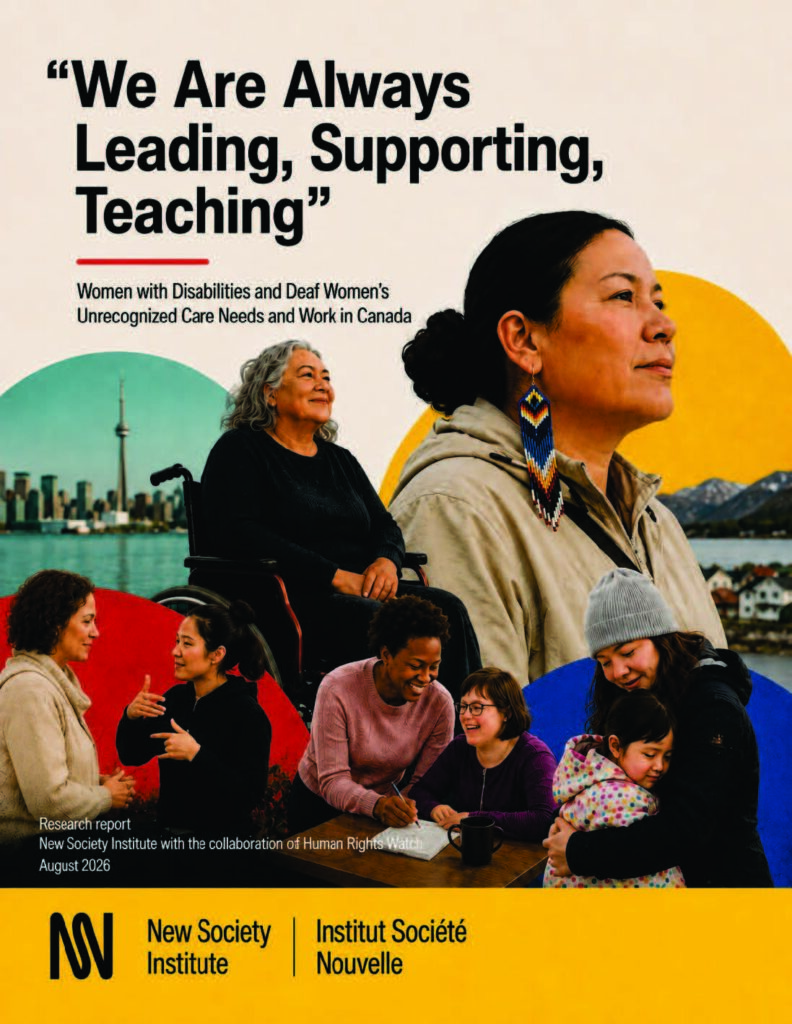
We Are Always Leading, Supporting, Teaching Women with Disabilities and Deaf Women’s Unrecognized Care Needs and Work in Canada

February 04, 2026
Режим правосуб’єктності в Україні: системний збій у забезпеченні прав людей з інвалідністю

February 04, 2026
Ukraine’s Legal Capacity Regime: Failing People with Disabilities – Report (English Version)

November 13, 2025
Toronto – A Place to Call Our Own: EMPOWERING WOMEN TO TAKE ACTION FOR AFFORDABLE HOUSING
Intellectual Disability and Employment
This report looks at the employment situation of people with intellectual disabilities in Canada. It is based on the Participation and Activity Survey of 2006 (PALS), which has been Statistics Canada’s ‘flagship’ survey on disability. The report focuses on people who self-identified on PALS or who were identified by proxy as being told by a doctor, psychologist or other health professional that they have a developmental disability or disorder. The report provides comparisons against people with other disabilities (i.e. who have a disability, but answered “no” to the question on developmental disability). Where feasible, comparisons are also drawn with people without disabilities. It provides general demographic information, as well as a brief exploration of functional limitations and needs for disability-related supports that people with intellectual disabilities may be experiencing.
Related
September 01, 2026
We Are Always Leading, Supporting, Teaching Women with Disabilities and Deaf Women’s Unrecognized Care Needs and Work in Canada
February 04, 2026
Режим правосуб’єктності в Україні: системний збій у забезпеченні прав людей з інвалідністю
February 04, 2026
Ukraine’s Legal Capacity Regime: Failing People with Disabilities – Report (English Version)
November 13, 2025
Toronto – A Place to Call Our Own: EMPOWERING WOMEN TO TAKE ACTION FOR AFFORDABLE HOUSING
Pride and Prejudice
What values and attitudes do Canadians hold on matters of impairments and handicaps, of who they think of as disabled, on what they understand to be a disability, and on which institutions in society are responsible for taking action for advancing the inclusion of persons with disabilities? To take up these questions, this paper examines the 2004 benchmark survey and focus group results on Canadian attitudes toward disability issues commissioned by the Office for Disability Issues, Social Development Canada. The paper posits that public thinking on issues of disability is marked by contending attitudes and ideas of people with disabilities and by feelings of hesitancy and uncertainty over solutions for their social inclusion.
Related
September 01, 2026
We Are Always Leading, Supporting, Teaching Women with Disabilities and Deaf Women’s Unrecognized Care Needs and Work in Canada
February 04, 2026
Режим правосуб’єктності в Україні: системний збій у забезпеченні прав людей з інвалідністю
February 04, 2026
Ukraine’s Legal Capacity Regime: Failing People with Disabilities – Report (English Version)
November 13, 2025
Toronto – A Place to Call Our Own: EMPOWERING WOMEN TO TAKE ACTION FOR AFFORDABLE HOUSING
Mixed Signals
This paper provides a look at various policies, programs and practices that relate to Canadians with disabilities. The purpose is to present a sense of the state of affairs for disability organizations—service providers, consumer organizations, and advocacy groups—in contemporary Canada. The paper advances an argument for strengthening community capacity and developing active partnerships among governments, the disability community, and the community-at-large, towards the goal of eliminating or reducing, as much as possible, the mixed agendas encouraging organizations to work together on issues of common interest.
Related
September 01, 2026
We Are Always Leading, Supporting, Teaching Women with Disabilities and Deaf Women’s Unrecognized Care Needs and Work in Canada
February 04, 2026
Режим правосуб’єктності в Україні: системний збій у забезпеченні прав людей з інвалідністю
February 04, 2026
Ukraine’s Legal Capacity Regime: Failing People with Disabilities – Report (English Version)
November 13, 2025
Toronto – A Place to Call Our Own: EMPOWERING WOMEN TO TAKE ACTION FOR AFFORDABLE HOUSING
Learning Difficulties Snapshot
The purpose of this research paper is to provide policy-relevant baseline information that will inform public policy regarding the population of people with learning and/or developmental disabilities. It explores selected demographic and other characteristics of adults 15 years and older classified as having ‘learning difficulties’. It draws from Statistics Canada’s 2001 Participation and Activity Limitation Survey (PALS), the research literature and other documentation and insights gathered from community-based experience. The report generally focuses on people residing in households (i.e. noninstitutionalized) and provides basic demographic information, including age, gender, economic family status, province of residence and size of community, visible minority and immigration status, and aboriginal person status. It goes on to explore issues of education, employment and income, help with everyday activities, health, personal control in decision-making and participation in leisure activities in the community.
Related
September 01, 2026
We Are Always Leading, Supporting, Teaching Women with Disabilities and Deaf Women’s Unrecognized Care Needs and Work in Canada
February 04, 2026
Режим правосуб’єктності в Україні: системний збій у забезпеченні прав людей з інвалідністю
February 04, 2026
Ukraine’s Legal Capacity Regime: Failing People with Disabilities – Report (English Version)
November 13, 2025
Toronto – A Place to Call Our Own: EMPOWERING WOMEN TO TAKE ACTION FOR AFFORDABLE HOUSING
Coming Together Report
On February 13, 2008, Community Living Manitoba hosted a day long event which uncovered issues surrounding individuals with intellectual disabilities. Entitled ‘Come Together 2008’, the conference brought together police officers, government representatives, advocates and individuals with intellectual disabilities and their families. Areas which became recurring themes in the conference included the vulnerability of people with intellectual disabilities, and the issue of overprotection was discussed. Trying to find a balance, the conference provided key insights on topics, such as relationships and informal safeguards, power, control and choices for individuals and criminal justice process and formal safeguards. This report provides a summary of key points and directions for action that emerged from discussions at the conference.
Related
September 01, 2026
We Are Always Leading, Supporting, Teaching Women with Disabilities and Deaf Women’s Unrecognized Care Needs and Work in Canada
February 04, 2026
Режим правосуб’єктності в Україні: системний збій у забезпеченні прав людей з інвалідністю
February 04, 2026
Ukraine’s Legal Capacity Regime: Failing People with Disabilities – Report (English Version)
November 13, 2025
Toronto – A Place to Call Our Own: EMPOWERING WOMEN TO TAKE ACTION FOR AFFORDABLE HOUSING
When Bad Things Happen
This publication discusses violence, abuse and neglect of people with disabilities. Particularly, looking at women from Manitoba, the research study sets out to provide evidence that Manitoban women face unique circumstances which further marginalize them. Using focus groups, it concluded that Manitoban women are facing physical, mental and sexual mistreatment, amongst other things. Identifying ‘gray’ areas, the paper calls upon the Government of Canada to provide better statistics on women who are in vulnerable groups, especially women with disabilities. This data would be useful for policy makers to have in order to make better decisions and provide support services.
Related
September 01, 2026
We Are Always Leading, Supporting, Teaching Women with Disabilities and Deaf Women’s Unrecognized Care Needs and Work in Canada
February 04, 2026
Режим правосуб’єктності в Україні: системний збій у забезпеченні прав людей з інвалідністю
February 04, 2026
Ukraine’s Legal Capacity Regime: Failing People with Disabilities – Report (English Version)
November 13, 2025
Toronto – A Place to Call Our Own: EMPOWERING WOMEN TO TAKE ACTION FOR AFFORDABLE HOUSING
CAILC Safety Symposium Report
In 2003, the Canadian Association of Independent Living Centres (CAILC) received funding from the National Crime Prevention Partnership Program, Public Safety and Emergency Preparedness Canada for “Crime Prevention and Independent Living; A Pan-Canadian Initiative for People with Disabilities”. CAILC is a non-profit, national bilingual umbrella organization supporting a network of 26 member Centres across Canada to promote the full participation and integration of persons with disabilities. This report provides an overview of key themes that emerged at the National Safety Symposium: Crime Prevention and Independent Living. The Symposium was convened and hosted by the Canadian Association of Independent Living Centres (CAILC) and the Ottawa Police Service in Ottawa, April 28–30, 2005.
Related
September 01, 2026
We Are Always Leading, Supporting, Teaching Women with Disabilities and Deaf Women’s Unrecognized Care Needs and Work in Canada
February 04, 2026
Режим правосуб’єктності в Україні: системний збій у забезпеченні прав людей з інвалідністю
February 04, 2026
Ukraine’s Legal Capacity Regime: Failing People with Disabilities – Report (English Version)
November 13, 2025